Last Friday night my friend Roger and I went out in search of the northern lights. The space weather forecast looked promising for a good showing of the Aurora, however nature had other plans. We watched and waited until almost 3:00 AM but never saw any lights. We did, however, experience some incredible moonlight. Almost the entire night there were these low-altitude, fast-moving clouds drifting by overhead. When we came upon this pine tree with the moon directly behind it, we knew we had to photograph the scene. This photo was made at 1:25 AM and was a 30 second exposure taken with a Canon EF 17-40mm lens.
Sunday, December 7, 2014
Moonlight Sentinel
Last Friday night my friend Roger and I went out in search of the northern lights. The space weather forecast looked promising for a good showing of the Aurora, however nature had other plans. We watched and waited until almost 3:00 AM but never saw any lights. We did, however, experience some incredible moonlight. Almost the entire night there were these low-altitude, fast-moving clouds drifting by overhead. When we came upon this pine tree with the moon directly behind it, we knew we had to photograph the scene. This photo was made at 1:25 AM and was a 30 second exposure taken with a Canon EF 17-40mm lens.

Saturday, December 6, 2014
Mt Rainier Storm & Flood Damage Photos - Carbon/Ipsut
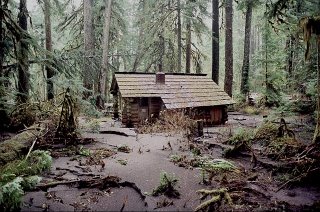 The NW corner of the park usually has its own share of flood related damage each year. And though it's not unusual for there to be Carbon River inspired washouts, this rainstorm brought substantially more destruction to the area. For example, here is the idyllic Ipsut Creek Cabin. It suffered heavily during the flood. Is it me, or does this place remind you of Yoda's house on Dagoba?
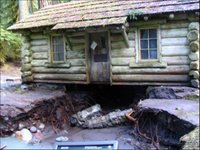 This creek diversion gives literal meaning to the name, Ipsut Creek Cabin. If Yoda did live here, he'd have to use quite a bit of "the force" to fix things.
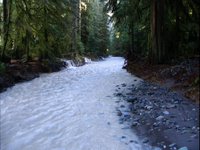 As for the Carbon River Road, more than two miles of it washed away in at least four separate spots. In some places, the river flowed down the middle of the road (like here). For climbers, this could spell delay in early season attempts of Liberty Ridge.
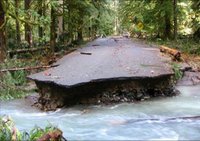
AND another washout closer to Ipsut Creek Campground.
As for the Wonderland and other park trails, here's a brief run down on the storm damage. Keep in mind, the full extent may not be known till next spring, as these assessments were made from the air. For now, backpackers should probably expect things (bridges) to open up later than normal next summer. There are at least 10 bridges out around the Wonderland Trail. New trail needs to constructed in four other places. That includes a half mile reroute between Lake James and Cataract Creek and another 750 foot section in Stevens Canyon. NPS Photos
Friday, December 5, 2014
Gt Staughton - Stonely - Dillington - Gt Staughton
 |
| Mini-reservoir with 'scarecrows' at each corner |
 |
| Barry and Gordon crossing a(nother) muddy field. |
 |
| Crow scarer. |
 |
| Tiny brown splodge = deer |
 |
| Pylons near Graffham Water |
Looking South
 From the Crest of the Sandia Mts you can look almost in all four directions. It was so hazey that day that we weren't getting the best views as you do on some days. I didn't get any good ones from the walkway but did get this one at the start of one of the trails where you can actually hike from the top of the Crest all the way down into Albuquerque, about 11,000 feet down.
Tuesday, December 2, 2014
Competition
Although I’ve spent my whole adult life involved in sport, I still have big reservations about large parts of it. I’ve read a lot of work on the history and philosophy of sport, and to be perfectly honest, a good chunk of it makes for depressing reading. I wish more of it could be more like the way it’s supposed to be.
The fact that climbing on mountains and cliffs is hard to pin down, hard to reduce to numbers and results and competition was quite an important aspect of what drew me into it. It’s hard to say ‘I had a better adventure than you’. Even as a climbing coach, I’ve sometimes been uneasy seeing young climbers come up against some of these negatives. Sometimes I wonder if I should say ‘skip the comp this time’. Go and explore somewhere new with some friends and come back for the next comp. As well as providing the essential ability to see outside the bubble of the scene, the perspective might well make a better competitor in the long run.
Kev pointed to this picture on Facebook, of a Basque athlete helping a Kenyan who’d stopped running a few metres short of the finish line in a cross country event, thinking he’d already passed it. The Basque runner could have run right past and won the race. But he stopped to direct the Kenyan over the line, staying behind and keeping the place he would have got if the Kenyan hadn’t made a simple human error. The surprising thing for me was that the attention this story got was as a ‘rare’ piece of sportsmanship. Why shouldn’t it be the norm?
After getting my ankle surgery in November, I decided to enter a running race for the first time, and see how it went. I thought it would be good as a goal to help get me back on my feet and moving fast in the mountains again. I entered the West Highland Way Race for next June. Although I have done quite a lot of hill running at different times over the past year or two, like anyone getting involved in a new scene I was a bit nervous about how welcoming it would be to someone who is known as ‘a climber’. Yesterday a friend told me about this thread started about my entry, which was a bit of a downer. When I experienced this sort of thing as a teenager doing sport at school, I hated it, avoided it and eventually found it’s antidote in going climbing. This time round I don’t need to react like that. But if I am able to recover from my injury enough to do it, it will be weird to stand on the start line knowing I’m standing with others who feel I don’t deserve to be there. My slowly healing ankle joint is the only thing that would stop me earning a place. As I said on the thread, if anyone feels I really don’t deserve the chance as much as them, drop me a line and I’ll offer to withdraw and donate my place.

Monday, December 1, 2014
My Favorite Kind of Day

Since we spent all summer in Florida, and Florida in the summer is a dreadful experience temperature and humidity-wise, we are really enjoying the cooler days. We went out to Sixteen Hands and spent the day there alone because everyone else went to an event. It was just a lazy kind of a day.


The horses are starting to really know Nathan now. They greet him and then go and do their thing. Well, except Patriot who believes "we" are his thing.

Gypsy girl shows us how she multi-tasks by drinking and bathing at the same time.

And Chevy bravely walks over to me, rather than running away from me.

It was a good day! Hoping for more of them over the next few months!
Living the life in FL!
Saturday, November 29, 2014
David Byrne and 'Urban Revolutions' at MIT
Last night I was at the Urban Revolutions panel at MIT with velo-friend Biking in Heels. This was not something I planned to attend, but she had an extra ticket and I was free - so I came along. The event featured talks by musician David Byrne, director of Boston Bikes Nicole Freedman, director of the LivableStreets Alliance Jacqueline Douglas, and associate director of SENSEable City Lab (inventors of the "Copenhagen Wheel") Assaf Biderman.
 In case some might not know, David Byrne was the lead singer of the Talking Heads and has since been involved in a number of artistic and musical projects. Most recently, he has become known for his cycling advocacy and for his book on the subject, Bicycle Diaries. Over the past year Byrne has been on tour giving talks throughout North America on the topic he describes as "Cities, Bicycles, and the Future of Getting Around". Cambridge, MA was his latest stop.
 David Byrne came across as thoughtful, knowledgeable and funny. His talk was neither gimmicky nor too heavy on the advocacy; I would put it more into the category of Urban Planning. He summarised the history of how our un-neighborhoodly neighborhoods came to be the way they are and discussed potential solutions, with urban planning initiatives and the return of "everyday cycling" being the primary points of focus.
 Jacqueline Douglas and Nicole Freedman (pictured above next to Byrne) discussed similar ideas, but applied them specifically to Boston - stressing activism and grassroot movements as catalysts of change. They noted that Boston's cycling infrastructure has basically been created from scratch over the past 2-3 years, and that the number of cyclists in the Boston area has increased dramatically over this period of time. Douglas and Freedman plan to continue this trend, with a particular emphasis on infrastructure in the form of traffic-segregated bike paths.
 The large MIT lecture hall was full for the duration of the event, with the audience listening intently and enthusiastically.
 Somewhat to my surprise, the Q&A panel following the individual talks did not result in much debate. Namely, I expected vehicular cyclists to comment on the segregated paths issue, but this did not happen. Perhaps there were not any in the audience? Or else the speakers so clearly allied themselves with the Amsterdam/Copenhagen model, that the vehicular cyclists decided not to bother stirring the pot.
 Biking in Heels (the lady in red) got in the queue to ask a question - but alas they stopped right before it would have been her turn.
 After the event was over, the most popular panelist was Assaf Biderman of the SENSEable City Lab - demonstrating the "Copenhagen Wheel" to those who wanted to try it.
 The Copenhagen Wheel turns any existing bike into an electric bike and "differs from other electric bikes in that all components are elegantly packaged into one hub". The energy spent while pedaling and braking is used to power the motor, and tons of additional features (including route planning and pollution levels detection) are bundled inside the hub.
 The Copenhagen Wheel is meant to be a versatile option that will allow more of the population to cycle - including those who are elderly, have trouble handling hills, or do not feel fit enough to ride a bike. While I have no interest in electric bikes myself, I think that this option makes perfect sense for those who need it.
 What does not make as much sense to me, is the decision that the prototype bike housing the Copenhagen Wheel should be a sleek, fixie-looking, diamond frame bike with aggressive geometry, narrow tires and "bullhorn" handlebars. It just doesn't seem to fit the population for whom the Copenhagen Wheel was designed. My suggestion to the SENSEable City Lab, is to put the wheel into a bike that is more accessible to the general public.
 Also popular after the event was this nice woman from the LivableStreets Alliance, asking people to fill out requests for improvements they would like to see done to the Charles River bridges. Given that I almost get run over by cars 75% of the time I try to cross an intersection at the end of one of these bridges, I gladly filled out a form with my requests.
All in all, Urban Revolutions was an interesting event to attend. If I seem detached in my descriptions, it is because to a large extent I felt that the panel was "preaching to the choir". I suspect that most of the audience had heard and internalised all that was brought up by the speakers long before coming to this event. Furthermore, for all the talk of "equity" and "equal access" that went on, the audience was almost entirely White, and dressed in a way that suggested a very narrow demographic. What exactly, then, was this event meant to achieve? Perhaps a sense of community among existing cyclists and supporters of "livable streets" ideas. At that it was a success. Despite my aversion to "activism", I am genuinely glad that cycling is becoming more commonplace and safer in Boston. And I am thankful to all who play a role in making this happen.
In case some might not know, David Byrne was the lead singer of the Talking Heads and has since been involved in a number of artistic and musical projects. Most recently, he has become known for his cycling advocacy and for his book on the subject, Bicycle Diaries. Over the past year Byrne has been on tour giving talks throughout North America on the topic he describes as "Cities, Bicycles, and the Future of Getting Around". Cambridge, MA was his latest stop.David Byrne came across as thoughtful, knowledgeable and funny. His talk was neither gimmicky nor too heavy on the advocacy; I would put it more into the category of Urban Planning. He summarised the history of how our un-neighborhoodly neighborhoods came to be the way they are and discussed potential solutions, with urban planning initiatives and the return of "everyday cycling" being the primary points of focus.Jacqueline Douglas and Nicole Freedman (pictured above next to Byrne) discussed similar ideas, but applied them specifically to Boston - stressing activism and grassroot movements as catalysts of change. They noted that Boston's cycling infrastructure has basically been created from scratch over the past 2-3 years, and that the number of cyclists in the Boston area has increased dramatically over this period of time. Douglas and Freedman plan to continue this trend, with a particular emphasis on infrastructure in the form of traffic-segregated bike paths.The large MIT lecture hall was full for the duration of the event, with the audience listening intently and enthusiastically.Somewhat to my surprise, the Q&A panel following the individual talks did not result in much debate. Namely, I expected vehicular cyclists to comment on the segregated paths issue, but this did not happen. Perhaps there were not any in the audience? Or else the speakers so clearly allied themselves with the Amsterdam/Copenhagen model, that the vehicular cyclists decided not to bother stirring the pot.Biking in Heels (the lady in red) got in the queue to ask a question - but alas they stopped right before it would have been her turn.After the event was over, the most popular panelist was Assaf Biderman of the SENSEable City Lab - demonstrating the "Copenhagen Wheel" to those who wanted to try it.The Copenhagen Wheel turns any existing bike into an electric bike and "differs from other electric bikes in that all components are elegantly packaged into one hub". The energy spent while pedaling and braking is used to power the motor, and tons of additional features (including route planning and pollution levels detection) are bundled inside the hub. The Copenhagen Wheel is meant to be a versatile option that will allow more of the population to cycle - including those who are elderly, have trouble handling hills, or do not feel fit enough to ride a bike. While I have no interest in electric bikes myself, I think that this option makes perfect sense for those who need it.What does not make as much sense to me, is the decision that the prototype bike housing the Copenhagen Wheel should be a sleek, fixie-looking, diamond frame bike with aggressive geometry, narrow tires and "bullhorn" handlebars. It just doesn't seem to fit the population for whom the Copenhagen Wheel was designed. My suggestion to the SENSEable City Lab, is to put the wheel into a bike that is more accessible to the general public.Also popular after the event was this nice woman from the LivableStreets Alliance, asking people to fill out requests for improvements they would like to see done to the Charles River bridges. Given that I almost get run over by cars 75% of the time I try to cross an intersection at the end of one of these bridges, I gladly filled out a form with my requests.All in all, Urban Revolutions was an interesting event to attend. If I seem detached in my descriptions, it is because to a large extent I felt that the panel was "preaching to the choir". I suspect that most of the audience had heard and internalised all that was brought up by the speakers long before coming to this event. Furthermore, for all the talk of "equity" and "equal access" that went on, the audience was almost entirely White, and dressed in a way that suggested a very narrow demographic. What exactly, then, was this event meant to achieve? Perhaps a sense of community among existing cyclists and supporters of "livable streets" ideas. At that it was a success. Despite my aversion to "activism", I am genuinely glad that cycling is becoming more commonplace and safer in Boston. And I am thankful to all who play a role in making this happen.
Subscribe to:
Posts (Atom)