Wednesday, August 22, 2012

The Final Scanning Spree!

Ten days ago I began the final push to get the last of the family pictures scanned. This scanning project was actually started in mid-April of last year. Four months later I reported that I was nearly done with my own pictures and my Mother's albums, except for those of my sister's family, which my niece was going to sort and organize. My original goal had been to have them scanned by the end of March of this year. In January she handed the box of pictures over to me but then I got sick and the best laid plans were put aside. . . Only two months behind schedule, but the family picture project is finally finished. Yaaay!

Actual time spent scanning during those ten days was 30 hours and probably just as much time spent doing a final sort of the pictures, trimming them, attaching them to acid free card stock, and adding a brief caption (who was in the picture and a date). This scanning spree generated 1233 image files that now consume 1821mb (1.8gb) of my hard drive. Most of these photos were snapshots 3x5" or smaller so they were each scanned at 600 dpi using the Canon CanoScan LiDE 90 scanner. No color corrections or contrast adjustments were done during scanning. The goal was simply to get them scanned!

After scanning, the completed pages were inserted into plastic protective pages and put into 3-ring binders, which took a few more hours ;-) The albums were delivered to my Mother yesterday afternoon. She was very happy to get them back and I am extremely happy to be done with them!!!

This picture of my sister, taken in 1954, certainly needs some retouching done on it, which may be beyond my current abilities. Thank goodness, most of the other pictures were in much better condition than this one.

This little cutie, my sister's grandson, graduated from 8th grade tonight. He'll be 15 in October and is now nearly 6' tall. He towers over most of the kids in his class.

Monday, August 20, 2012

Sunday walk in Mollebos and tea at Het Wapen van Rijsenburg

Officially it’s spring in the Netherlands now but we are still very much in winter conditions. Along the coast, waters have frozen into beautiful forms, the temperatures still hover under 0C by day and the omnipresent wind is making sure it feels like -10C.


But this did not stop the Dutchman and I in going out for a walk in the forest. It has been a long time since we did something like this. In fact I have been curling up at home in my chair for the past weekend’s mainly because every weekend was themed with horrible weather—grey, cold, rainy or snowy. You do not want to get out when the weather is like this, except that, I’ve had it. I’ve really had it.


It is supposed to be spring, and I don’t care if the weather is not cooperating, I’ve had enough of staying in! I am going out =)


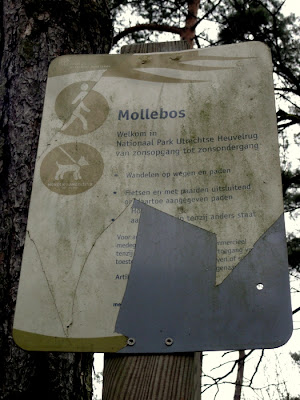
Mollebos forest walk in Utrechtse Heuvelrug


We decided to go to Driebergen-Rijsenburg in the Utrechtse Heuvelrug because its nearby. The Utrechtse Heuvelrug is a massive national park forest in Utrecht (in central Netherlands). It is in fact a conglomeration of forests, from small forests to bigger ones. We followed the sign to Het Grote Bos but ended up going into a much smaller forest—Mollebos.


Dutchman and I walked here for an hour. Because it was a relatively small forest, we ended up going around in circles. We’ll check out the other forest—Het Grote Bos next time.


Tea and apple tart at Het Wapen van Rijsenburg


Then it’s tea time!


The ‘Het Wapen van Rijsenburg’ restaurant is probably the best place to have lunch, tea and dinner in Driebergen-Rijsenburg. It’s location is quite strategic, right on the main street of the village with the view to the old church and the village boutique shops.


We indulged in some hot tea and apple tart from the house with whipped cream. Dutchman liked the apple tart while I thought it was a bit dry.


A slow yet a very fulfilling and relaxing Sunday it was.


Visit Period: March

Destination: Driebergen-Rijsenburg (Utrechtse Heuvelrug – Utrecht), The Netherlands


Sunday, August 19, 2012

Rivendell Sam Hillborne: Floor Model Test-Ride at Harris Cyclery

[edited to add: There is now also afull review of this bicycle, written after 6 months of ownership]


As mentioned previously, I received aRivendell Sam Hillborne framefor the holidays. It was a joint gift from several parties, purchased atHarris Cyclery.Here are all the beautiful Rivendell frames that were hanging at Harrisat the time (Atlantis, orange Hillborne, and green Hillborne). The one on the right became mine. I was excited to get the last green frame in my size: They are being replaced by the orange, but that gorgeous green was the colour I wanted.


Some of you expressed surprise that I got a diamond frame and not the Betty Foy. But I specifically wanteda diamond frame that I could fit with drop bars and use for sporty, long-distance rides. My experiment with drop bars on my vintage Motobecanedid not work out last summer, but I do miss them. The one thing Rivendell bikes are known for, iscomfortable geometry, making the Hillborne perfect for trying to conquer drop bars again. So that was the rationale behind this frame. Receiving a frame rather than a finished bicycle does put financial responsibility on me to come up with the funds for parts. But I think that's great, as building up the bike will keep me obsessed/entertained for months.


This is a built-up Harris floor model in the same size as the frame I got: 52cm, with 650B wheels. It is fitted with gorgeous red Grand Bois Hetre tires (650B x 42mm), Nitto Moustache handlebars, and a Brooks B17 saddle. I will probably fit mine with the white version of these tires and with Nitto Noodle bars, as well as add some fenders.


Before deciding on the Hillborne frame, I took the floor model for a short ride. It was a freezing day and the ground was covered with patches of snow, which created interesting test-ride conditions. But this was not the first time I had test-ridden the Hillborne; I have tried both him and Betty earlier in the Fall.


As you can see, I have been perfecting my leg-swing technique and no longer have too much of a problem mounting diamond-frames. (I was actually kind of proud that I could do this in a floor-length parka!)


There are many things that attracted me to the Hillborne, but what truly swept me off my feet was how comfortable and stable it felt. Even with the Moustache bars on the floor model being set too far out for me, I felt comfortable riding it in traffic. And the geometry allows me to keep my leg extended when pedaling, while still being able to reach the ground with a toe - Splendid!


The proportions of the 52cm Hillborne frame seem to suit me well. This is a notable contrast to the Betty Foy, whose 52cm frame feelstoo small. (This, and several other discrepancies between Betty and Sam make me question Rivendell's description of them as being basically the same bike.)


The Moustache bars on the floor model were handsome, but after trying them a few times over the past several months I do not think they are for me. I feel that they present the same challenges as drop bars, but without the benefit of offering as many hand positions. So I think I will stick with the plan to get drop bars.


These are such nice looking handlebars though, and I know that some people, like Alan at ecovelo, are very happy with them - so it is a matter of personal preference.


This pretty much concludes my Hillborne test ride report. I like the way Harris builds up their floor models and will only make a few changes when I build up mine. The main one, is that I plan to get a dynamo hub (Shimano Alfine) for the front wheel, which should be exciting. I am looking forward to riding my own version of this bicycle in Spring!

Friday, August 17, 2012

Flowers, Fruit, and Pack-Along Plants

This post "Flowers, Fruit and Pack-Along Plants" was written by Annie in Austin for the Transplantable Rose.


Breaking news from Chicagoland: Do you remember seeing a peach tree in full bloom at my sister's house? It sprouted 4 years ago when my my nephew Jake and his parents planted a Harry & David peach pit. Jake is proud to announce there are real peaches hanging from those branches!
Memorial Day weekend is sometimes called the Gateway to Summer, but we in Austin passed through that gate quite a while ago. Yesterday was another hot day, reaching 99 degrees Fahrenheit in the afternoon, the kind of day where the birds hide and only the bugs look busy and you hope for any little movement of the air. Then with a whoosh, the wind swept in yesterday evening, tossing the trees and plunging us into the low seventies overnight, rebounding to the nineties by lunchtime.
I was sure the 'Cupani' Sweet peas would fade once the heat hit, practically writing their obituary in the May 15th Bloom Day post, but they fooled me - still hanging their rose and blue-violet flowers on the obelisk near the 'Black Knight' butterfly bush, the Tropical orange & yellow milkweed, Salvia farinacea and yellow lantana.
The Pink Entrance Garden never had its photo taken for Bloom Day - there doesn't seem to be any time of day when photos taken there are free of shadows or glare or there isn't something ugly intruding on the view. This one taken looking NW toward the street isn't too bad, once I carefully cropped the trash cans from the photo!


Facing back in the direction of the garden gate you can see that one plant of 'Purple Stars' Coneflowers have finally opened, rioting with pink gaura, heirloom petunias, some lingering larkspur, the first balloon flowers and at lower right, a fully loaded pink chrysanthemum. This spring bloom cycle of chrysanthemums seems normal to me now, but I was surprised back in .. to find that a plant that was a sure sign of fall in the north was both a spring and fall plant in Texas.
The 'Little Gem' magnolia is never covered in flowers, but it opens them one or two at a time, off and on once May arrives, enough so there is a light fragrance whenever I'm within 10 feet of the small tree. I caught this flower after it opened, but before pollination led to the stamens browning and dropping into the cup of the flower.
In the previous post I talked about Austin Passalong Plants - but what can we call those toted-from-one garden to another plants that we originally bought from a nursery? I think they must be Pack-Along Plants. The daylily below is 'Prairie Blue Eyes', one of the daylilies that I brought from my Illinois garden in 1999. It barely survived life on the deck at the other Austin house, dwindling down to one leaf by the time we moved to this house in July ... After we made the Hummingbird garden that winter I planted the tiny thing, and was pleased to see it thrive.... it has five budded stalks this year! But no matter how beautiful the flowers are, the thing that looks and smells like summer for many of us are tomatoes. We have enough room to make a 10X10-foot tomato patch at this house, but could have used a few of VDBD's Grow-Boxes at our previous house so we could have grown tomatoes on the deck instead of keeping them enclosed in a wire structure. Meems has been taunting us for weeks with the tomatoes she's harvesting from her Florida garden! Vertie in Hyde Park had lots of green tomatoes last, but was a little too busy being part of a Central Texas Gardener taping to give us the current status.

A few days ago Bonnie at Kiss of Sun
showed us her vegetable garden and mentioned that the 'Brandywine' tomato wasn't doing much. We planted one of these potato-leaved heirlooms, too - and it's finally starting to make flowers.
That's the only variety without at least a few green fruits-in-progress. Philo made a new structure for the tomatoes this year, an interlocking wooden grid with the plants lightly looped up just enough to keep them off the ground. In the North many tomato growers prune excess leafage and tie the plants to stakes so they get more sun. Down here I've seen advice to use foliar feed and adequate water in order to produce lots of leaves, in order to give protection from excess sun to the developing fruit. That's what we're trying this year.


Last year's flooding was not good for tomatoes, and we still wonder whether traces of Juglone from too many pecan leaves in the garden had a negative effect. Since last fall we've added lots of cotton bur compost and also used products like John Dromgoole's Terra-Tonic for soil. It's hard to know whether what happens in a vegetable garden is actually a result of anything we've done or if it's a response to things beyond our control, like weather, but the plants do look better than in either .. or ...
Leave the fruit on the plant one minute past the pale orange stage and you can kiss it goodbye- some bird or critter will get it. The tomatoes take just a few days inside to be ready to eat. We've already eaten a dozen of the small, grape-shaped 'Juliet' tomatoes and those slightly larger 'Viva Italia' plums will soon be red. Large slicing tomatoes for sandwiches may still be a dream, but Pico de Gallo can be a reality!


This post "Flowers, Fruit and Pack-Along Plants" was written by Annie in Austin for the Transplantable Rose.

What The Cheaters Have Done To Us?


photo courtesy of unknown author on the web


The followingis a comment Mark Twight made first on the paid portion ofhis Gym Jones web site, http://www.gymjones.com/and then published again else where prior to CT having Mark's permission to post it here.Mr. Twight's voice has been missedway too long fromthe climbing community. Please do not copy or duplicate any part of this essay. It is copyrighted material and property ofMr. Twight. It is published hereonly with his permission.


What The Cheaters Have Done To Us

By Mark Twight


The other day I happened across some remarks on the web congratulating someone for having climbed Mount Everest. Of course, and as is the norm, the protagonist made his way up there having hired guides, who fixed the ropes he ascended, who supplied oxygen, who mitigated the risk, who engaged local help to carry his gear and set up the camps where he slept.


One can argue that climbing is an individual sport and "he" did not climb the mountain. One might argue with equal vigor that him standing on the summit was the result of teamwork and that mountaineering is a team sport.


I could agree with the notion that it's a team sport on some levels, and that fixed ropes can have a place in some forms of climbing however the use of oxygen has no place, is cheating and overrules all other claim to achievement. Supplemental O2 is doping - without question. It is not a medical necessity, which is proven by many, many ascents of 8000m peaks without supplemental O2.


Why isn't supplemental oxygen viewed as doping? Some argue that it is a safety issue, that they do not want to take the risk of altitude illness, or frostbite. They want to, "experience climbing Everest," but can't or won't confront the challenge naturally so they modify that experience by boosting their own performance. If O2 allows one to accomplish a task that he or she otherwise could not do or was not willing to do then O2 is a performance-enhancing drug and should be treated as such.


Sadly, when someone who has climbed Everest with the aid of supplemental O2 and a "servant" to carry the extra bottles and prepare the route tells a rapt audience of non-climbers that he climbed Everest that is all he says. He fixates on the outcome and not the means used to achieve it. And if the audience isn't well-informed enough to ask about the means the speaker lets the omission slide, allowing them to think better of him. A decade and more ago I cared deeply about the way we climbed more than whether we were successful. We tried to address naturally existing challenges with a minimum of technological advantages and tried over and over to answer the question, "How light is too light?" If we had learned the answer through actual experience I wouldn't be writing this. We came real close though.


Now I see supplemental oxygen as part of a much larger problem. As human beings, familiar with the history of the species and its potential, we dearly want to believe in extraordinary human performance. Many genuine, rare and truthful accomplishments paved the way for our belief in what might be done. Back in the day when something amazing was reported our first response was awe, inspiration, and maybe the brakes we placed on ourselves slackened a bit.


Times have changed. Cheating is commonplace and doping is rampant, even at the lowest levels of sport. When I look across a variety of disciplines it is apparent that no one is special and no one is immune: when a group of human beings get together some percentage of them are going to cheat or be susceptible to the idea of it. Sadly, it appears this is true for any sport and at some point our habit as an athlete or spectator becomes one of distrust. These days most great accomplishments call up a voice inside urging skeptical review.


People lie on resumés and cheat on tests to get jobs - not caring that they won't be able to DO the job if they get it. Amateur athletes lie about their accomplishments to invite positive social feedback - without caring that a lie is being praised, instead accepting the praise out of context. Pro athletes cheat to win, or to stay competitive against other cheaters, and do so for both money and prestige. Eventually they convince themselves the dope didn't help, that they deserved the medal, the reward, the status. That doping is so common has changed how we respond to the announcement of a spectacular performance or achievement.


Sadly, our skeptical reaction further imprisons us within the limitations we set for ourselves or accept from others who set limits for us. If we greet every great performance with suspicion what becomes of its potential to inspire? What means will we use to unlock our own potential? Who will plant the guideposts along the trail? What new level of performance by one or two individuals will free the hundreds struggling just beneath them?


This is what the cheaters have done to us. It is why we must expose and oppose them whenever it is possible.

Tuesday, August 14, 2012

Keith Eugene Phend 1922-1943

My niece and I spent all day this past Wednesday taking apart Mom's photo albums and sorting the pictures into "family" stacks - one for her pictures, a stack for each of us four kids, and additional stacks for each of her siblings. There was 2 shelves worth of albums that consumed about 48" worth of space on her bookshelf. Now we have to sort and sequence each of those stacks.

While sorting those pictures in Mom's albums, the thought that there would be any surprises never even crossed my mind. I thought I had seen all of the pictures before. Way back when I was working on the Phend Family History I had asked if anyone had pictures of Keith Phend, Mom's first cousin. Keith had been killed On October 25, 1943 in an airplane crash while in training at the Naval Station at Quonset Point Rhode Island. There didn't seem to be any pictures of Keith; none were received from his siblings.

So, back to last Wednesday. Sorting pictures. I don't remember which album they were in, but they were where they shouldn't have been. Two pictures clearly marked with his name, Keith Phend. Mom said she knew she had them but didn't know where, so when I asked it was easier for her to just say she didn't have any. . . Keith was born March 4, 1922. Neither picture is dated but the one as a young man is probably his high school graduation picture. Both pictures simply melted my heart, but especially the one of him as a young boy.


The obituary of Keith Phend as published in the October 30, 1943 edition of the Columbia City Post:

Local Youth is Killed Monday in Air Crash.

A telegram from the U.S. Naval commander of the station at Quonset Point, Rhode Island, received Oct. 26th by M. F. Magley told of the death of his grandson, Keith E. Phend, aged 21, in an airplane crash on Oct. 25.

Phend, who had recently completed his training as radioman upon a naval bomber plane, was in Columbia City on October 21 as the guest of his grandparents here. At the time of his visit here, he was on leave from the station in Rhode Island from Wednesday until Sunday. He had attained the rank of A.R.M. third class since his enlistment in the Navy on September 28, 1942 at Fort Wayne.

His preliminary training was secured at Great Lakes U.S. Naval Training school and thence he went to the Naval air training school at Jacksonville, Fla. He was transferred to the Rhode Island station only about six weeks ago.

The telegram announcing his death was as follows: "Deeply regret to inform you that Keith E. Phend was killed in an airplane crash on October 26, while in the performance of his duty and in the service of his country. Sincere sympathy is extended to you in your great loss." The telegram was signed by the Commanding Officer of the station. A telegram was received by his parents, Mr. and Mrs. Russell Phend, at their home at Springport, Michigan, telling of the tragedy.

The parents of the young man have advised Mr. and Mrs. Magley that the body will be sent to Springport, but that they plan for burial in Columbia City.

The victim of the plane crash was born in Columbia City on March 4, 1922 to Mr. and Mrs. Russell Phend, and attended school here in the grades. The family moved to Springport, where Mr. Phend has operated a service station for several years. Keith attended Jackson high school, from which he was graduated in the class of 1940. Following his graduation he assisted in the shop of his grandfather in Columbia City for nearly a year and then secured employment in the Freuhauf trailer plant at Fort Wayne, where he was employed when he enlisted in the Navy. While here he was a member of the Baptist church of Columbia City.

No details of the plane crash have yet been received by relatives in this city, nor by his parents in Michigan.

And, his funeral notice of November 1, 1943 also in The Post:

Naval Rites Held for Keith Phend.

Full military rites were held Saturday afternoon at 2:30 o'clock at the First Baptist church for Keith E. Phend, 21, A.R.M. 3/c, son of Mr. and Mrs. Russell Phend of Springport, Mich., who was killed in an airplane crash last Monday near Quonset Point, R. I.

The Rev. Walter Mickley, pastor of the church, was assisted in the funeral service by Rev. Marion R. Shroyer, pastor of the First Church of God, and the Rev. Edwin Bauer, naval chaplain from Bunker Hill. Members of the U.S. Naval Air Station at Bunker Hill attended the services in a group and served as the pallbearers, color guard and firing squad. Carter Diffendarfer, close friend of the family, served as head usher at the church. Committal services were held in Greenhill cemetery.

Miss Catherine Sarrich, vocal instructor in the public schools at Springport sang "My Buddy." Her piano accompaniment was played by Mrs. Lucille Lonsbery, also of Springport.

The rites held in this city followed a short service held at the Phend residence in Springport at 9 o'clock Saturday morning.

Monday, August 13, 2012

Step up and beyond


A late walk out on the Way after a lovely weekend just pottering around in the garden. Iam usually an early bird returning home with a photographic bonanza with a collection of critters, creatures and flaura with a big grin from ear to ear but Iam still happy with this photo of the A frame steps and clouds up and beyond.........