 Therese and Isabelle is a black and white film c. 1968 based on the novel by Violet Leduc. It is a coming-of-age story about a doomed love affair between two girls at a French boarding school. In the first half of the film, there is a scene where the girls are cycling along an endless tree-lined alley and laughing. (Not that it matters in the context of the film, but they are riding beautiful mixtes with hammered fenders and dynamo lighting.) This is probably the happiest and most idyllic point of the film - where joy, freedom, and limitless possibilities are the dominant themes. Later it all ends badly, but the cycling scene is the antithesis of the tragic ending.
 The Sheltering Sky is a 1990 Bertolucci film starring John Malkovich, based on the novel by Paul Bowles. It is about an aristocratic composer and his beautiful wife, who aimlessly travel around North Africa while trying to overcome complex marital difficulties. This film too ends badly. But before things go downhill, there is a bicycle scene - where the husband and wife are traveling through a stretch of the Sahara on his and hers Roadsters, with cream tires and rod brakes. Unlike any of the other trips they take together, this one is infused with positive emotion and hope for a future.
Though the two films could not be more different from one another, the bicycle plays the same symbolic role in both: representing hope, joy, freedom, and simplicity. At the same time, in both films the bicycle is also used as a symbol of the unsustainable. "It is not possible for things to stay this good," the cycling scenes suggest, thereby foreshadowing an eventual tragic ending. In order for these associations to work as cinematic tools - which in both films they do - there has to be a deeply ingrained cultural perception of the bicycle as a symbol of escapism and wishful thinking; the bicycle is something that is incompatible with "real life". And this to me was very interesting to notice. Something to think about, at least.


 If you look at most cycling blogs today, the discourse tends to stress the social aspects of riding a bicycle. Cycling is presented as an activity that fosters a sense of community- with an emphasis on interaction with other cyclists, neighborhood initiatives, various workshops and co-ops, group rides, community action programmes, and city or state-wide coalitions.
 I find this interesting to observe, because to me the bicycle has always been a symbol of solitude - something that brings complete independence and freedom. When I think of "riding a bicycle," I imagine cycling for miles and miles through changing landscapes, alone with my thoughts and at peace with the world; a meditation of sorts. But I can certainly understand that others imagine group rides, bike workshops, and other social activities - they see the bicycle as a shared interest that makes it easy to connect to others.
 Often I am asked why I do not participate in group rides, and the reason is simply that for me socialising and cycling are two distinct activities that are best enjoyed separately. It makes me nervous to chat while trying to navigate traffic, so I fully enjoy neither the discussion nor the ride. I also feel that group rides - even slow ones - are more hazardous than cycling alone, because you have to watch out not only for traffic, but for the wheels of other cyclists; I know probably a half dozen people whose only cycling accidents happened during group rides. I can cycle pretty happily with one person at a time (though it depends on their style), but beyond that it starts to get stressful.
 This is not to say that I am "against" the socially-oriented portrayal of cycling. I just don't think that the bicycle = community association is universally applicable. And after all, it is rather fascinating that the bicycle can be a symbol of two diametrically opposite things: the social and the solitary.


 Stormy and Trave eating together.


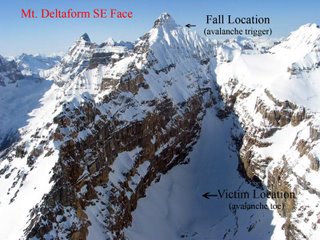 The information about Gabe was positive considering the fact that he was carried over 3,000 feet in an avalanche down the side of a major Canadian mountain! After the slide, Gabe fortuitously was not buried, but did end up spending three days and nights alone (at times in sub-freezing weather) on top of the debris.
 One challenge to expect when cycling in the winter, is that bicycle lanes tend to "disappear" - either under snow banks, or under cars that take overthe bike lane when snow covers their parking spots.
 The pictures here are of Day 3 after our latest snow fall, and the plows have been working continuously. Still, the snow banks cover a good three feet or more of the the righthand side of the road in both directions.
 For those who live in areas with well-developed cycling infrastructure, this change can be especially difficult: Accustomed to traveling almost exclusively via bike lanes, having to now cycle directly with car traffic can be a bewildering experience. That is one reason I think it is important to get comfortable with "vehicular cycling" even if it does not seem like you need it. Once the snow arrives, there is no way to tell what part of your journey will have the familiar bike lanes available and what part will dump you directly into the traffic lane.
 While side streets are quieter than main roads, the drawback is that they are not plowed as thoroughly. Here you can see that even the narrow space in the middle of the street is covered with a layer of snow. The car and the cyclist ahead must carefully navigate around each other in sharing this space, ideally at low speeds.
 In addition to the limited space, there is also a greater number of obstacles in the road than usual: There are newly formed pot holes, which are not infrequently iced over, and also just chunks of snow and ice strewn all over. Cycling can feel like a technical trial, where the cyclist is forced to do a little dance to avoid ice chunks on one side and potholes on the other - all while remaining keenly aware of the presence of cars behind them.
 I am not one to sensationalize the supposed dangers of cycling. But when the roads start to look like this, I think it is important to be aware of the potential pitfalls. All the things you took for granted earlier - from the texture of the asphalt, to the way your bike handles, to the availability of bike lanes, no longer hold true.
 When the weather is like this, all you can do really is know what to expect - and use your judgment to determine whether you can handle it. While the presence of bike lanes is not particularly important to me, the loose chunks of hard snow and ice are what deters me from cycling just now. It's too stressful to navigate around them while dodging cars, so I will wait it out. The Co-Habitant, on the other hand, is delighted to ride in these conditions. To each their own!